Stop the “Wall of Text” Freeze.
It is 8:30 PM on a Sunday. You are staring at a screen, trying to piece together a reading lesson for a mixed-ability class of 10-year-olds. You know exactly what is going to happen tomorrow morning: you will hand out a standard reading passage, half the class will finish in two minutes and start acting out, and the other half will look at that dense block of text, panic, and completely shut down.
We have all been there. I remember sitting at my kitchen table, dreading that specific silence that falls over a room when a reading activity is bombing. Big publishing companies love to sell heavy, expensive textbooks filled with generic stories about “John going to the grocery store.” But those don’t work when you are trying to keep a room full of pre-teens focused.
That is why we built these from the ground up right here in our Victoria office. If you need an ESL graphic novel PDF download that you can trust, you are in the right place. Every panel and exercise has been triple-checked by teachers who actually know what it takes to run a classroom. This is an A1 beginner ESL lesson plans PDF designed to give you your weekend back. You get high-quality reading material, and your kids get a story they actually want to decode.
Hitting CEFR A1 Reading Comprehension Without the Tears
Let’s talk about the actual benchmarks. When you are teaching to CEFR A1 or early Canadian Language Benchmarks, your students need to grasp basic, everyday words and very simple sentences.
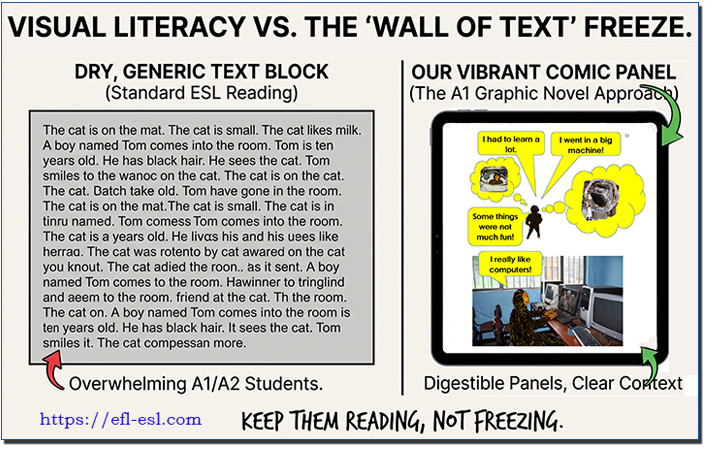
Big publishing companies usually tackle this by handing you a textbook filled with giant walls of text. They assume that because the words are simple, the format can be dense. But you and I know exactly what happens when a ten-year-old sees a full page of paragraphs. They freeze up. The tears start, or the pencils turn into drumsticks.
We take those exact same A1 vocabulary lists and grammar rules and break them down into digestible comic panels. Instead of a scary paragraph, your student sees just one or two sentences matched with a clear, colorful picture. The image does the heavy lifting for context. If the text says, “She forgot her umbrella,” the picture shows a girl standing in the rain looking shocked.
They are still hitting the required reading comprehension standards, but they feel like they are just reading a fun story. It takes the pressure off them, which immediately takes the pressure off you.

Jambo Goes to the Moon – Graphic Novel Version
Includes
- Word Bingo Games and Crossword Puzzles.
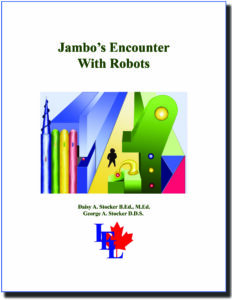
Jambo’s Encounter with Robots – Graphic Novel Version
Includes
- Word Bingo Games and Crossword Puzzles.
Learn More
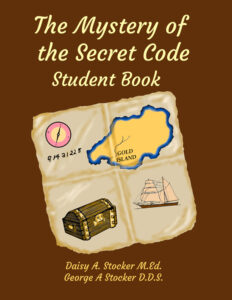
The Mystery of the .Secret Code – Graphic Novel Version
Includes
- Word Bingo Games and Crossword Puzzles.
Learn More
The "Stock the Classroom" Bundle
I know a lot of you are buying classroom materials out of your own pockets. If you want to grab all three of our children's graphic novels at once, we’ve bundled them together for you. You get the complete set and save 25% right off the top. It keeps your lesson plans full for the term, and keeps a little extra money in your wallet.Learn More or see our White label Curriculum
A Communicative Language Teaching Approach to Comics
If you hand out a traditional reading worksheet, the room usually goes dead silent. But language classes are supposed to be loud. When we were putting these modules together, we wanted to make sure these comics didn’t just turn into another quiet time activity.
Because graphic novels use speech bubbles and action panels, they are practically begging for a communicative approach. You don’t just want your students reading silently; you want them talking to each other.
Here is a trick I love using: before you even let them read the story, have them cover the speech bubbles with their hands or a scrap of paper. Put them in pairs and ask, “What is happening in this picture? Why does the dog look mad?” You are forcing them to predict the context and use their speaking skills before they ever read a single word.
Once they finally uncover the text, they can stay in their pairs and act out the scenes. Since the text is already broken into natural, bite-sized dialogue rather than dense textbook paragraphs, it instantly turns into a low-stress role-play. They aren’t just staring at a page of grammar rules; they are practising how people actually talk.
The “Mixed-Level Survival Guide”
Teaching A1-A2 reading to 8-12 year olds is tough because the gap between “gets it instantly” and “needs constant help” is massive. Here is the hidden hurdle: making the struggling students feel smart without boring the advanced ones.
We bridge that gap with visual anchoring. For your true beginners, the illustrations provide 80% of the meaning, giving them the confidence to guess the remaining 20% of the text. For your faster readers, our Teacher’s Guide includes “Extension Prompts”—small challenges asking them to write the next panel of the story. Everyone is working on the same page, but at their own speed.
White label Children’s Curriculum
We know how it goes when you’re running a language centre, a private academy, or a tutoring business. You want materials that look like they belong to you, not something you just photocopied out of a generic book.
That is why we offer a plain-English, straightforward white-label institutional license for this curriculum. When you pick up this tier, we remove our logos and branding from the PDF workbooks and teacher guides. You have our full permission to add your own school’s logo, stamp, or contact details directly onto the pages before you print them or hand them out to your students.
It lets you provide high-quality, classroom-tested materials to your families while keeping your own brand front and centre. No hidden legal hoops, no massive corporate royalties—just a simple license that works for your business. License Children’s Curriculum
Modified: 2026-06-30
Published: 2019-07-02